Storage Tank Safety with Combined Devices
Storage Tank Safety with the PROTEGO® Combined Pressure/Vacuum Relief Valves Flame Arresters Solution
Storage tank protection entails maintaining consistent pressure Pressure (gauge pressure) Pressure for which the value is equal to the algebraic difference between the absolute pressure and the atmospheric pressure. control and preventing flame transmission if potentially explosive atmosphere Explosive atmosphere A mixture of air and flammable substance in the form of gases, vapors, mists or dusts under atmospheric conditions in which, after ignition, spreads to the entire unburned mixture. is present in the tanks headspace.
ISO 16852 mandates combined flow and flame transmission testing when Pressure/ Vacuum Vacuum Vacuum is the pressure in an enclosed space that is lower than the ambient pressure. Relief Valves (P/V Valves) are used in combination with flame arresters.
However, many installations in the field are not tested as a combined unit and therefore don’t comply with ISO 16852 requirements. These issues may introduce increased risk in routine operations and emergency relief. A proven method of mitigating this risk is to implement fully tested, integrated solutions, such as PROTEGO®’s combined Pressure/Vacuum Relief Valves Flame Arresters Flame arrester Device fitted to the opening of an enclosure, or to the connecting pipe work of a system of enclosures, and whose intended function is to allow flow but prevent the transmission of a flame. unit for storage tank safety.
Why Testing a Combined Unit is Important
- Even minor pressure losses at subsonic flow can reduce a valve pallet Valve pallet Valve pallet is the generic term for the assembly that rests on the valve seat. 's lift Lift Lift is the actual travel of the valve pallet from the main valve out of the closed position. , compromising relief performance.
- Combining a flame arrester and a P/V valve can reduce flow or cause severe chattering during high-flow relief, when reliable protection is required.
- These effects potentially end in a catastrophic failure of the storage tank harming people and the environment.
Risks of Installing Flame Arresters Below the P/V Valve
Placing a flame arrester beneath the relief valve can result in additional hazards, such as:
- Increased clogging risk, which can cause storage tank collapse.
- Explosions or endurance burning Endurance burning Stabilized burning for an unlimited time. could potentially lead to catastrophic outcomes.
- The flame arrester element cannot be serviced without losing its ability to mitigate
explosions
Explosion
Abrupt oxidation or decomposition reaction producing an increase in temperature, pressure, or in both simultaneously.
.
Maintenance Maintenance Combination of all technical and administrative actions, including supervision actions, intended to maintain or restore a unit in working order. is difficult and time-consuming, particularly for larger sizes, which increases down time and OPEX significantly.
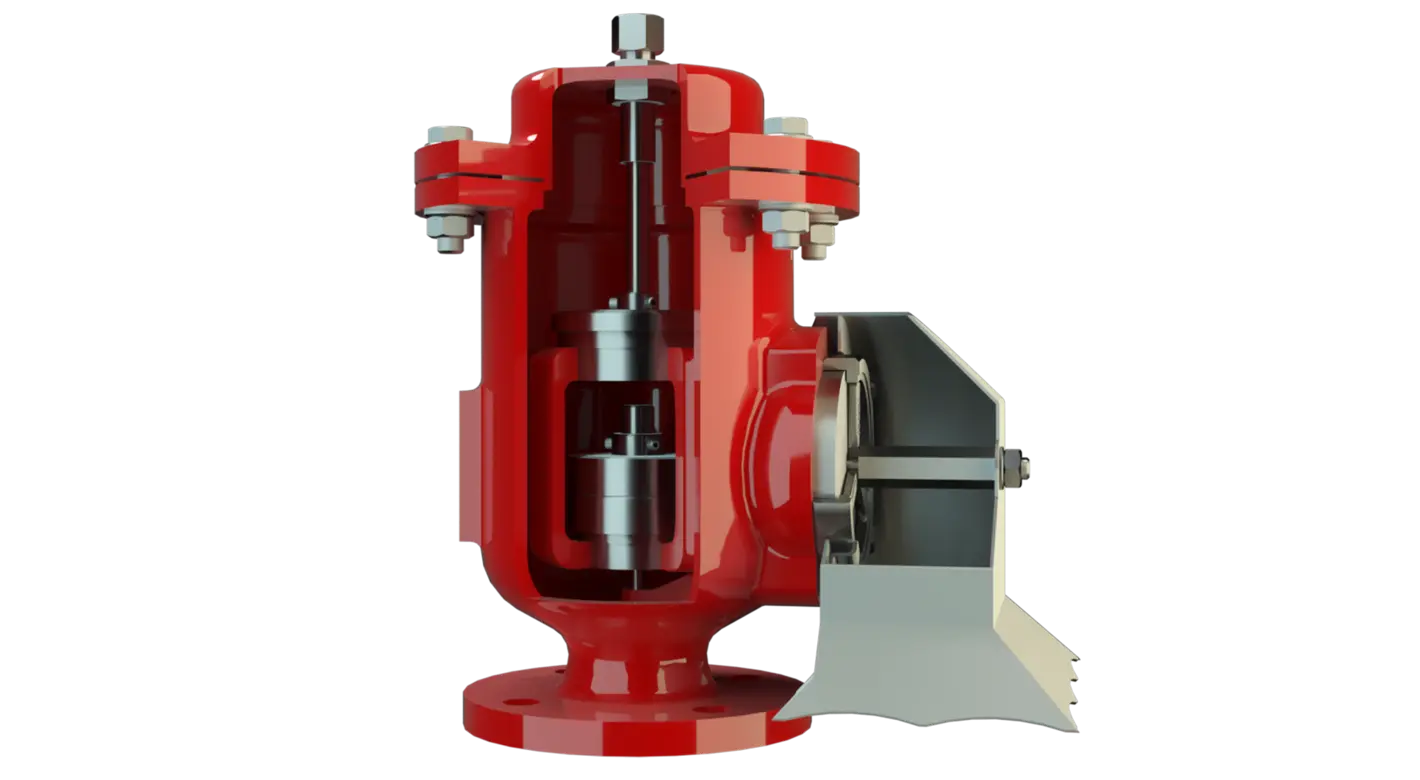
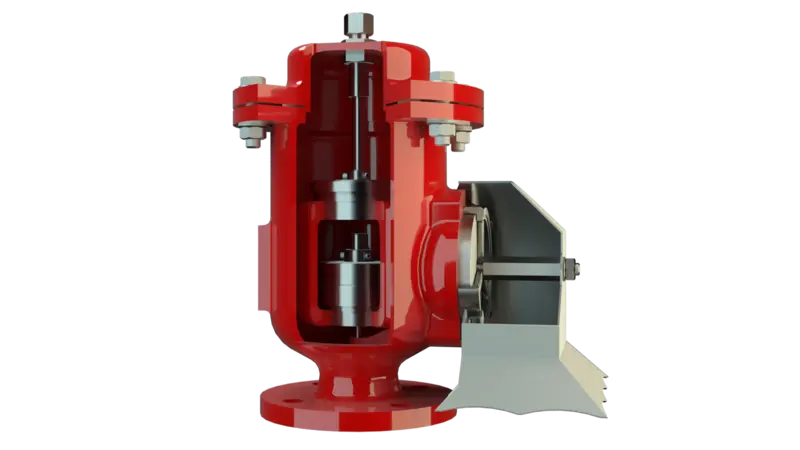
PROTEGO® offers Pressure/Vacuum Relief Valves that include an Integrated Flame Arrester, designed for safer protection of storage tanks.
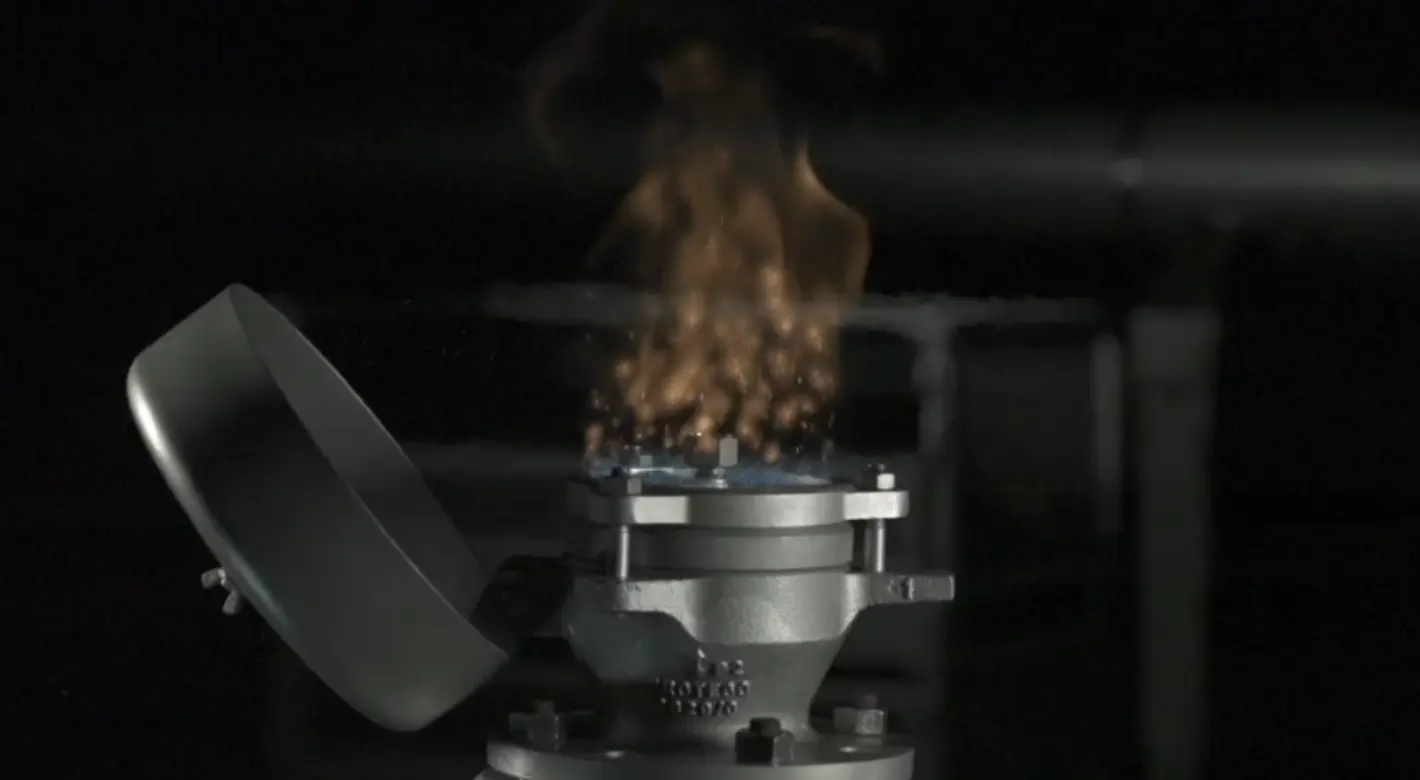
PROTEGO® provides devices that include a built-in flame arrester, which meets the flow test and explosion Explosion Abrupt oxidation or decomposition reaction producing an increase in temperature, pressure, or in both simultaneously. standards of ISO 16852 and offers extra protection for the environment and storage tanks.
Certified Compliance
- EN ISO 16852 and ATEX 2014/34/EU approved PROTEGO® VD/TS.
- Valve and flame arrester performance is guaranteed for all relief and explosion Explosion Abrupt oxidation or decomposition reaction producing an increase in temperature, pressure, or in both simultaneously. scenarios that may occur in accordance with the design case.
Certified Flow Performance
The flow curve of the combined device Device A device is a pipe component that influences the media flow by opening, closing, or partially shutting off the flow channel or by dividing or mixing the media flow. (flame arrester and P/V valve) is measured using a TÜV-certified flow test rig that complies with API 2000 (7th Edition) Standard.
Built for Real Operating Conditions
- The weather hood Weather hood A weather hood is a cover to protect the internal components of a device from environmental influences. has been optimized for use in severe weather conditions to prevent rain from blocking the flame arrester during vacuum operation.
- Electrical heating installation is possible with the standard design.
- Sensors can be installed to monitor device performance and track hydrocarbon emissions.
Maintenance Without Compromise
- Extremely maintenance-friendly construction.
- Routine inspection of the flame arrester results in no loss of explosion Explosion Abrupt oxidation or decomposition reaction producing an increase in temperature, pressure, or in both simultaneously. mitigation.
Lower Emissions and Risk
- 10% overpressure Overpressure Overpressure refers to an increase in pressure in a system or vessel above the normal operating pressure. technology reduces vapor emissions to a minimum. Very low leak rates in the parts per million (ppm) range help reduce explosion Explosion Abrupt oxidation or decomposition reaction producing an increase in temperature, pressure, or in both simultaneously. risks and promote environmental compliance.
Very low leak rates in the parts per million (ppm) range help reduce explosion Explosion Abrupt oxidation or decomposition reaction producing an increase in temperature, pressure, or in both simultaneously. risks and promote environmental compliance.
In summary
In summary, combining a P/V valve and a flame arrester necessitates verified, integrated performance and is not as simple as it may seem in the first place. Installations can experience pressure losses, restricted flow, or chattering if testing is not performed on the combined unit; maintenance can also become complex, risky and very cost intense. PROTEGO® addresses these challenges by providing independent third party tested, integrated, certified solutions that comply to ISO 16852 and API 2000 standards, are engineered for harsh environments, are maintenance optimized, and are designed to reduce emissions and risk to protect people and the environment.